
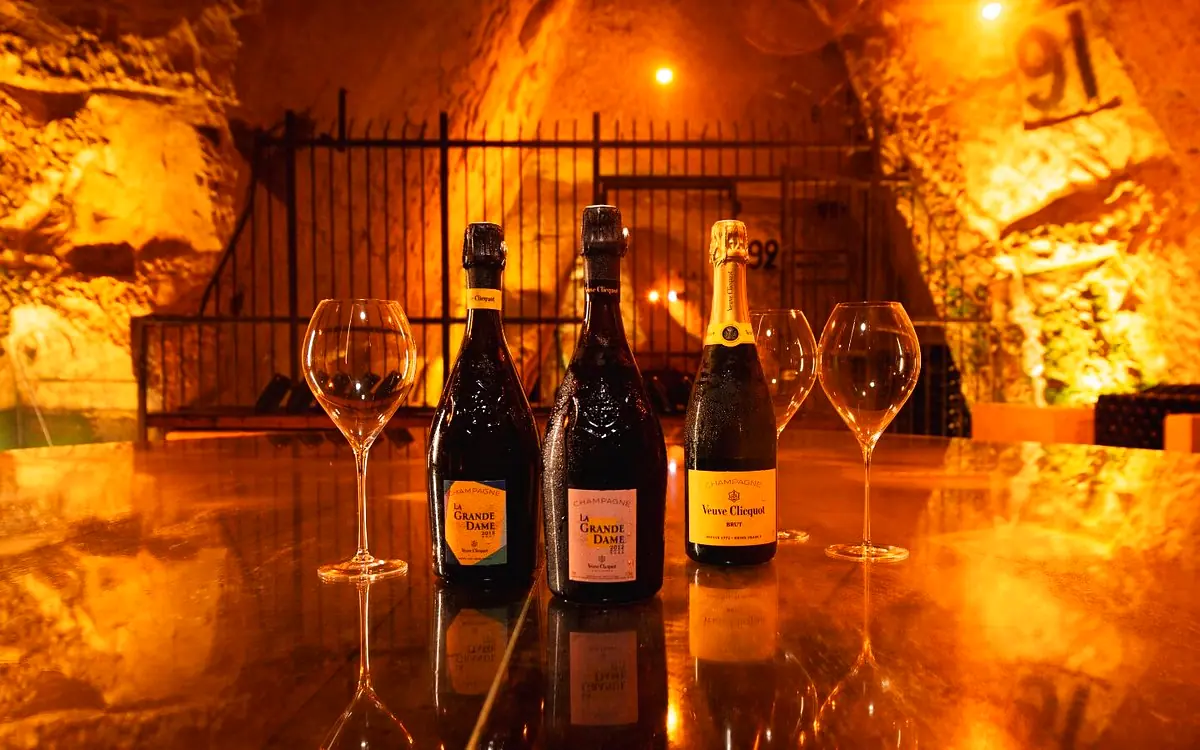
Acidity is an essential component of wine: it preserves it and gives it expression and character. In champagne, acidity runs at roughly 5 to 9.5 grams per litre.
Acidity is an essential component of wine. It preserves the wine and gives it expression and character (sometimes described as its backbone).
Too little acidity makes for a dull wine, too much makes it undrinkable. Acidity also emphasises colour. When a wine looks 'sparkling' or 'brilliant', that is not necessarily down to the visually perceived clarity of the liquid alone, but is often linked to higher acidity as well. In general, warm wine regions (Spain, for example) produce grapes with more sugar and less acidity, while cooler regions (such as Champagne) produce less sugar and more acidity.
The acidity of champagne is around 5 to 9.5 g/litre. Wine contains several kinds of acid. The important ones, in varying amounts, are tartaric acid (a strong fruit acid), malic acid (also a strong fruit acid), lactic acid (a mild acid) and tannins. In champagne it is also worth mentioning carbonic acid, which comes from the carbon dioxide behind the bubbles.
Tartaric acid is something of a rarity among fruits and is associated mainly with grapevines. It is considered somewhat stronger than malic acid, and also more 'stable'. It stays relatively constant as the grapes ripen, but it declines a little in the wine, because potassium and calcium readily bind chemically with tartaric acid. It is called 'stable' because it is rarely attacked by bacteria. Cellar masters therefore tend to boost the acidity of their wines with tartaric acid rather than with the less stable malic acid, for example.
During alcoholic fermentation, malic acid falls by a further 15% or so.
Malic acid, in turn, is found in many fruits. In excess (like tartaric acid) it can taste harsh in a wine, in the sense of biting. Malic acid is also often prominent in unripe grapes. Unlike tartaric acid, it breaks down progressively as the grapes ripen. In the wine regions of the south it is therefore often present only in small amounts at harvest. During alcoholic fermentation, malic acid falls by a further 15% or so. Under certain circumstances it is also attacked very aggressively by certain bacteria during winemaking, which is why it counts as rather 'unstable'. At the same time, malic acid is very important, whether in preserving it skilfully in the wine or in its conversion to lactic acid (natural, or encouraged by the cellar master). Because the harvest for champagne permits only optimal grapes (hand-selected), yields are lower for the growers (and the wine therefore dearer), but the champagne gains calculable advantages from the outset through ideal fruit, compared with many other wines in parts of the world where harvesting is often ruthless (quantity before quality). In the rather cool wine region of Champagne, a favourable level of acidity in the grapes at harvest can also usually be expected.
 De Castellane Champagner Shop
Lactic acid in wine does not come from the vines. A very small amount forms during fermentation, when the yeasts turn sugar into alcohol. After alcoholic fermentation (lasting about seven to ten days) comes what is often the so-called malolactic fermentation (about a month, or longer). In this fermentation, bacteria convert the natural malic acid into softer lactic acid. The wine also gains complex aromas during this phase.
Briefly, there is also citric acid, which is present in only small amounts in grapes. It accounts for just 5% or so of the acidity, though sometimes more in grapes affected by noble rot, or botrytis. In champagne, carbonic acid must also be mentioned.
Pictures



 0 %
