
Belemnites are extinct cephalopods whose fossilised rostra turn up in the chalk soils of Champagne. Belemnite chalk takes its name from them, a bedrock that shapes many of the region's finest sites.
Belemnites were relatives of the squid, with a slim, torpedo-shaped body. They lived in the seas of the Cretaceous and died out at the end of that era. What survives is mostly the rostrum, a chalky, cigar-shaped piece at the rear of the body that served the animal as a counterweight and stabiliser. In folk tradition these fossils were long known as "thunderbolts". If you scan the ground between the vine rows in Champagne, you can still occasionally find them today.
Belemnite chalk beneath the vines
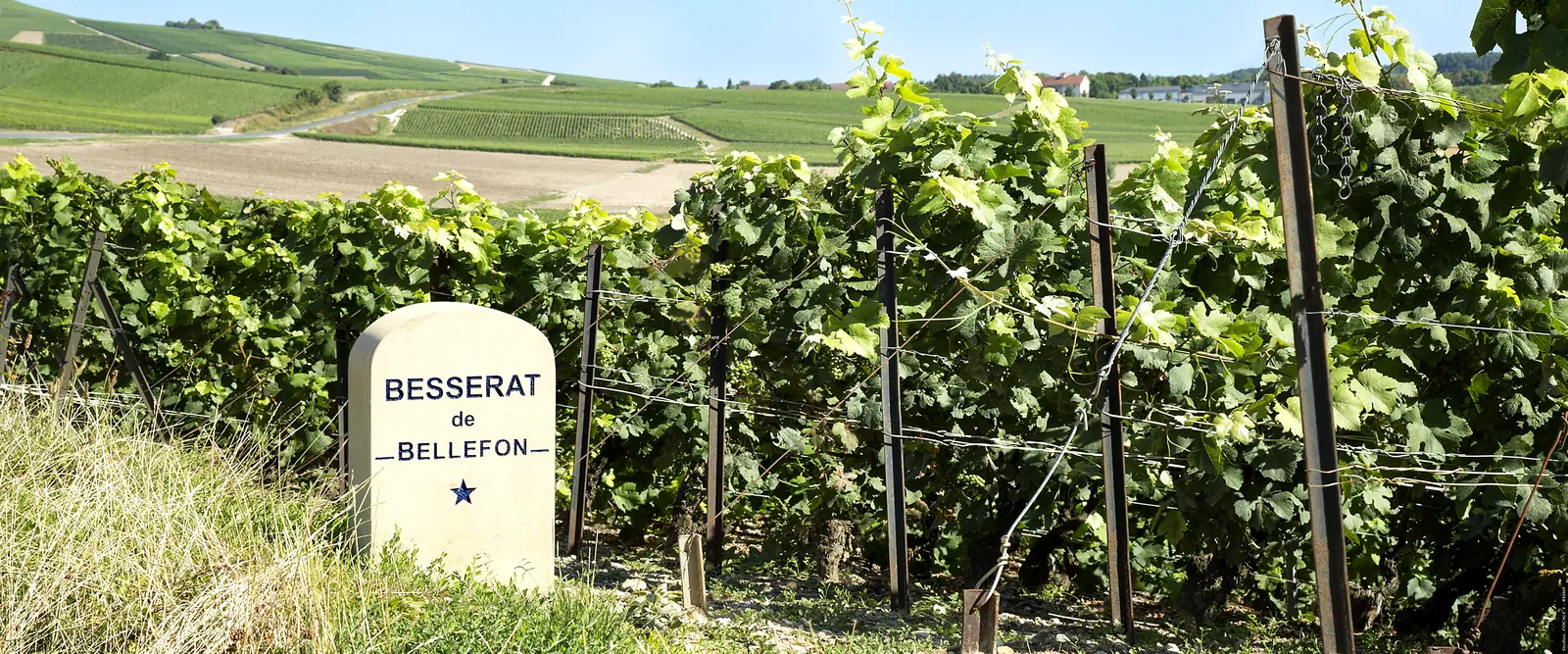
Champagne rests on a thick layer of chalk, formed from the lime mud of a prehistoric sea. Geologists divide it into strata according to their index fossils. The chalk containing Belemnitella species, known in French as craie à bélemnites, belongs to the younger part of this sequence. It comes to the surface in important wine-growing zones, or lies just beneath a thin layer of topsoil, particularly on the Côte des Blancs and parts of the Montagne de Reims.
Why it matters in the vineyard
The belemnites themselves make no wine. What counts is the rock they lie in. This chalk is porous and holds water like a sponge. In dry spells the layers release it slowly to the vines, and after heavy rain they drain away the excess well. The roots reach deep into the subsoil, and the pale ground reflects light back up, which can help the grapes ripen.
Many growers and cellar masters link the chalk with the tension, freshness and fine salinity found in many champagnes, especially those made from Chardonnay. Exactly how rock and flavour connect is hard to prove scientifically. Even so, chalk is regarded as a defining part of the terroir, and belemnite chalk is its best-known form.
Chalk, cellars and culture
The soft rock was easy to quarry. In Reims this gave rise to the crayères, underground chalk pits that now often serve as wine cellars. There, temperatures stay cool and constant all year round, ideal for long ageing on the bottle. Belemnites thus link earth history and winegrowing: the sea floor of the Cretaceous became the ground on which champagne grows and matures.
Pictures


 0 %
