
Clarification covers every step used to remove solids and yeast from the must and the wine. In champagne it falls into three phases: <em>débourbage</em> before fermentation, fining and filtration afterwards, and <em>remuage</em> and <em>dégorgement</em> at the end of bottle ageing.
Clarification means removing suspended particles, solids and yeast from the must and the wine. In Champagne this does not happen at a single point but in three phases: before the first fermentation, after the first fermentation and at the end of bottle ageing.
Before fermentation: débourbage
Freshly pressed must is cloudy. It contains bits of skin, cell fragments and particles of soil. During débourbage the must rests, chilled, in the tank, usually overnight or a little longer. The solids sink to the bottom and the clear must is drawn off. This matters for the purity of the aromas, because a must that is too cloudy can later bring green or bitter notes into the glass. The press already separates the fractions: the first juice, the cuvée, and the later pressings, the taille, are clarified separately.

After the first fermentation: fining and filtration
Once the base wine has finished fermenting, it is racked off the yeast (soutirage). It can then be fined (collage). Fining agents such as bentonite or proteins bind fine haze particles and settle out as a deposit. Filtration and cold stabilisation often follow, so that no tartrate crystals fall out in the bottle later. Some growers and houses deliberately skip fining or filtration. They want to leave the texture and expression of the wine as unaltered as possible. If you drink vegan, it is worth asking: some fining agents are of animal origin, though plant-based alternatives exist.
In the bottle: remuage and dégorgement
For the second fermentation the wine goes into the bottle with liqueur de tirage and yeast. After ageing on the lees, the bottle is full of yeast sediment, which has to be removed. To do this, the bottle is gradually turned upside down. This is done by hand on the pupitre or mechanically in the gyropalette, and the movement is called remuage. The deposit collects in the neck of the bottle.
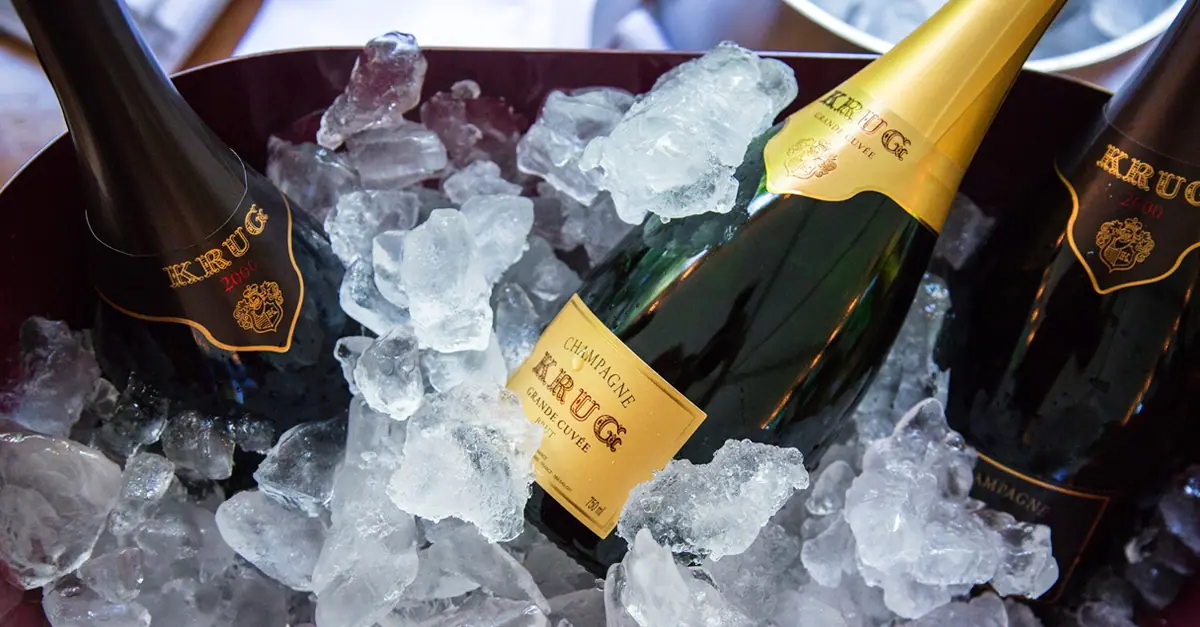 Krug Champagne
At dégorgement the neck is frozen. The crown cap is removed and the pressure of the carbon dioxide pushes out the plug of ice along with the yeast. What remains is clear champagne, which is then rounded off with the dosage and corked.
Clarification therefore plays a part in determining clarity, purity and style. The late step in particular shows the appeal of the method: the yeast gives brioche and nutty aromas over months or years and is only removed right at the end.
Pictures





 0 %
