
The Balthazar is a champagne bottle holding twelve litres, the equivalent of sixteen standard 75 cl bottles.
The Balthazar is one of the great large formats of Champagne. It holds twelve litres, the contents of sixteen ordinary bottles. As with many of the large formats, the name comes from the Bible and recalls Balthazar, one of the Three Wise Men. It has nothing to do with the region itself, only with the tradition of the champagne houses of giving their formats names from the Old and New Testaments.
Where it sits in the range of formats
The series starts with the standard bottle at 75 cl. Then come the magnum (1.5 litres), Jéroboam (3 litres), Réhoboam (4.5 litres), Mathusalem (6 litres) and Salmanazar (9 litres). After that comes the Balthazar at 12 litres, with the Nabuchodonosor at 15 litres above it. Anyone who finds a Balthazar for sale is therefore looking at a real showpiece.
Production and ageing
After the prise de mousse, the second fermentation, champagne ages on its lees. With large bottles this process is technically demanding. The glass has to withstand the pressure of the carbon dioxide, and the bottles can hardly be moved by hand any more for remuage and dégorgement. For this reason the largest formats are often not fermented in the bottle in which they are later sold. Instead, finished wine is decanted from smaller bottles. Among connoisseurs the magnum is regarded as a particularly good format for ageing, because the ratio of wine to the air cushion in the bottle is favourable. With the Balthazar, the spectacle matters more than any proven advantage in taste.
Then come the magnum (1.5 litres), Jéroboam (3 litres), Réhoboam (4.5 litres), Mathusalem (6 litres) and Salmanazar (9 litres).
Serving and handling
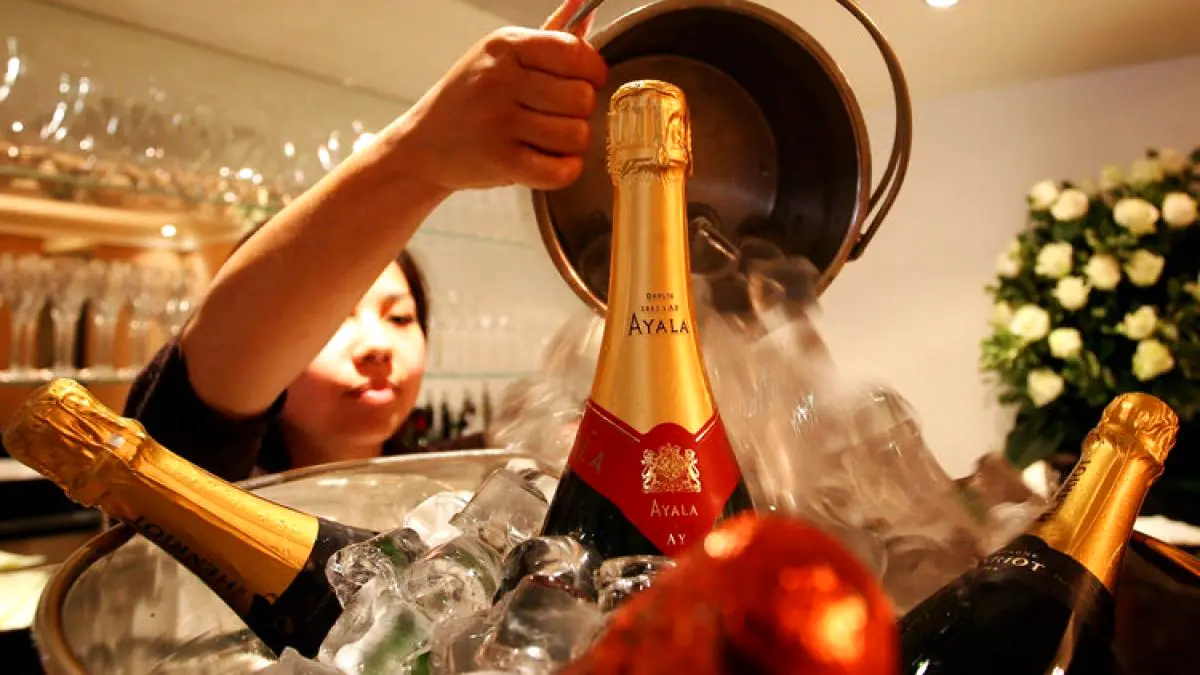
A full twelve-litre bottle is heavy and cannot simply be picked up and poured. It is usually tilted in a cradle or handled by two people. Chilling also takes preparation. An ordinary ice bucket will not do: you need a large vessel with plenty of ice and water, and enough time for the temperature to fall evenly. When opening, the rule is: ease the cork out in a controlled way, don't let it pop.
A Balthazar makes sense above all for big occasions such as weddings, anniversaries or receptions, where many glasses are filled at the same time. For private enjoyment among a small group it is impractical. If you want to experience the ageing qualities of large formats, a magnum will serve you better.
Pictures


 0 %
