
Phylloxera (Phylloxera vastatrix) is a vine pest introduced from the USA that destroyed Europe's vines from the 1860s onwards. It did not reach Champagne until 1890.
Phylloxera vastatrix (also known as Phylloxera vitifolii, Viteus vitifolii, Dactylosphaera vitifolii and Daktulosphaira vitifoliae) was brought to the south of France in the 1860s on experimental vines from the east coast of the USA, by way of London. By 1900 most of Europe's vines (Vitis vinifera L.) had either been infested or already destroyed. This devastating plague only reached Champagne, far to the north of the country, in 1890. At first the pest was largely ignored in southern France. Once it had truly proved its frightening destructive potential, however, every conceivable method of control was tried. Even a different species of louse (Tyroglyphus phylloxera), regarded as the arch-enemy of phylloxera and harmless to vines, was imported. Unfortunately this louse did not feel particularly at home in the European climate and proved useless. Treating the foliage with chemicals such as sulfure de carbone (carbon disulphide) looked promising at first sight, but in the end was also ineffective, because it only hit one stage of phylloxera's complex life cycle. What the growers of the time did not realise is that their infested vines were, in practical terms, hosting two forms of the pest at once: the leaf form (gallicola) and the root form (radicicola).

What growers spot on the foliage of their infested vines is already an advanced stage of the life cycle. These (leaf) lice suck at the leaves and at the same time release saliva into the sap channels, which in turn causes growths (galls) on the underside of the leaves. These small galls form around the wingless lice (gallicolae), with a tiny opening to the surface of the leaf. In these galls the louse lays, in some cases, several hundred tiny, lemon-coloured, oval eggs. After about eight days new young lice hatch from the eggs and attack the vine's foliage in turn, form new galls and lay yet more eggs. This part of the cycle produces three to six generations of phylloxera, mainly over the summer months. In the end the leaves turn brown and lifeless and drop off. Some of the lice on those leaves move on beforehand, while the others fall to the ground with them (at this stage the lice are called neogallicolae-radicicolae).
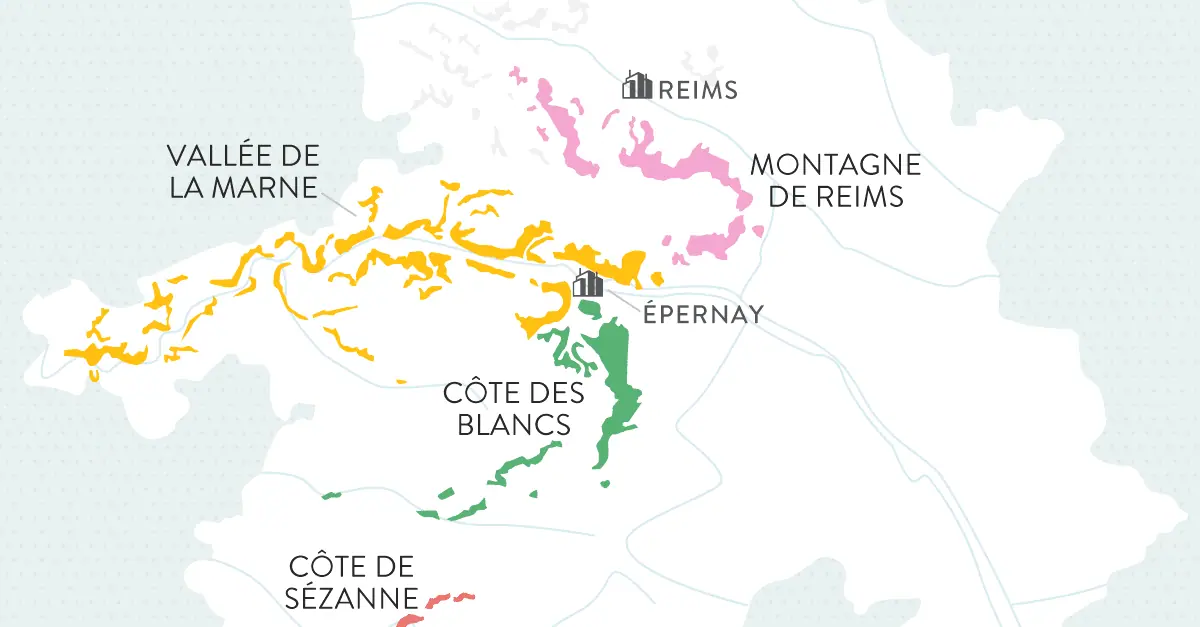 Landkarte der Champagne, Lexikon
Once there, they carry on their mischief at the roots (these lice are now known as radicicolae). The state of the foliage would no doubt have annoyed experienced growers at the time, but it surely did not seem particularly alarming at first, since similar parasitic side effects had long been known in the cultivation of vines and even hops. What they did not suspect is that, although the leaf phase of phylloxera is rather insignificant, these young lice had meanwhile also settled in the roots of their vines, where they overwinter as nymphs. What is more, the (root) louse and the nymph are almost invisible: they resemble the roots in colour and are very small (0.7 to 1 mm). In spring the vines come back to life with the season, the nymphs shed their skin, suck at the roots, form galls, and busily lay eggs again. Underground, too, this produces three to six generations of phylloxera. At first the roots are not seriously damaged by the louse. As the end of summer approaches, some of the hitherto wingless lice grow wings. In autumn they leave their underground home, infest the same vine above ground, or travel and fly to other vines. Unmated, they lay about 5 eggs each somewhere near the ground on the vine or under the leaves of the newly infested vines, and then die. The eggs laid are either small (male) or large (female). About two weeks later new lice hatch, this time male and female. They exist only for reproduction and have no organs for feeding as parasites. They mate, and the mother lice each lay a single olive-green or brown 'winter egg' (about 0.27 x 0.13 mm), normally hidden in crevices in the bark of the vine. This egg either overwinters hidden in the bark, or a new mother louse (1 to 2 mm long) may hatch as early as the same year. This louse is regarded as the 'stem mother' (fundatrix) and turns to fresh foliage on the vine, forming a gall in which hundreds of eggs are then laid. From these the (leaf) lice develop again, and the cycle repeats. After two to three years the vine dies (mainly as a result of root damage), and any remaining lice move on to the next vine.
When a grower discovers the leaf symptoms, it generally means that vines nearby have probably been infested for a long time already. Grubbing up the infested vines, even right down to root level, is generally pointless. On the contrary, it can even help the pest to spread, since when the vine and its roots are removed, the lice can be carried into new regions in the joints and crevices of tools and farm equipment (even on the workers' boots or in baskets).
By 1900 most of Europe's vines (Vitis vinifera L.) had either been infested or already destroyed.
Left to itself (without human 'help'), phylloxera spreads rather slowly (about 25 to 30 km a year). The winged lice generally cover only very short distances (with an ideal tailwind, however, 30 km is conceivable). The wingless lice, too, are occasionally blown by the wind onto nearby vines. Lice also travel underground to the intertwined roots of other vines. Favourable climatic conditions (a warmer climate) promote the life cycle.
 Aperitif Champagner
Let us return briefly to Champagne as it was then. The cooler climate meant that phylloxera made only slow progress at first. Growers in Bordeaux, for example, had long been deep in the fight against it, which gave the growers of Champagne ample warning (and experience of control methods) in advance. The plague was hardly 'unexpected' in Champagne, then. A meeting of all the growers in Champagne was therefore called in Épernay on 13 June 1891, to face the new enemy together. The motto of the French musketeers, 'All for one and one for all', had precious little to do with the vineyard owners of Champagne, however. Of the 25,729 vineyard owners at the time, only 17,370 signed up to the new 'Syndicat de Défense'. This incomplete syndicate could hardly stop the advance of phylloxera, but it did slow it down somewhat. Meanwhile someone in France had evidently noticed that the vines originally imported from the USA were doing splendidly despite phylloxera, in other words that they enjoyed a large measure of immunity to it. Grubbing up the native vines was therefore necessary, and the order of the day was swift replanting with phylloxera-resistant American rootstocks, grafted with native varieties. Even so, phylloxera struck the not yet grafted vines on an alarming scale. By 1910 half of the vineyards in the Marne were already hopelessly infested.
There were, and still are, several options for growers (not only in Europe) for combating phylloxera successfully. By far the preferred solution in Europe was, and is, to use rootstocks of phylloxera-resistant American species (for example Vitis riparia, rotundifolia, berlandieri, rupestris, lambrusca), followed by grafting on the European Vitis vinifera L varieties (grafted vines). The various American rootstocks are said to differ, however, in the quality and yields of the fruit of the vinifera vines. According to a report in the Sonoma County Viticulture Newsletter, phylloxera does not particularly favour the leaves of the European Vitis vinifera L varieties anyway (see the note on the PDF file below).
Another solution was to grow the American vines themselves (such as the well-known Noah and Isabella).
American vines were also successfully crossed with European ones. This gave rise to well-known hybrid varieties such as Baco, Delaware and Othello.
Historically, phylloxera is regarded as the greatest disaster ever to strike viticulture in France (and Europe). On the other hand, before the pest arrived France was positively flooded with numerous inferior grape varieties, often in unfavourable sites. When the necessary replanting on American rootstocks came, growers made sure that only the best native varieties in their good sites received the considerable investment of work and money that grafting demanded. Phylloxera also remains an international problem for growers in Europe and many other countries (including, for example, the west coast of the USA). On top of that, the biology of phylloxera is still not fully understood to this day. Even NASA has looked into it. Alarmingly, mutations are now being talked about as well. The fight against phylloxera is therefore nowhere near won.
Pictures



 0 %
