
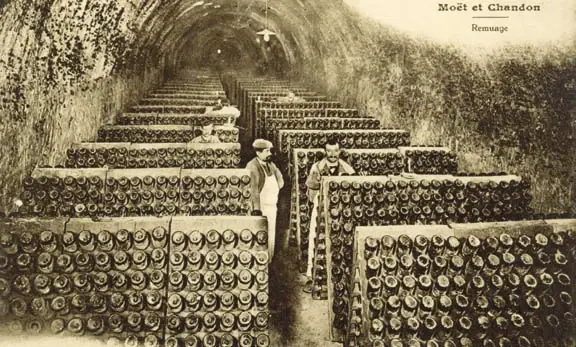
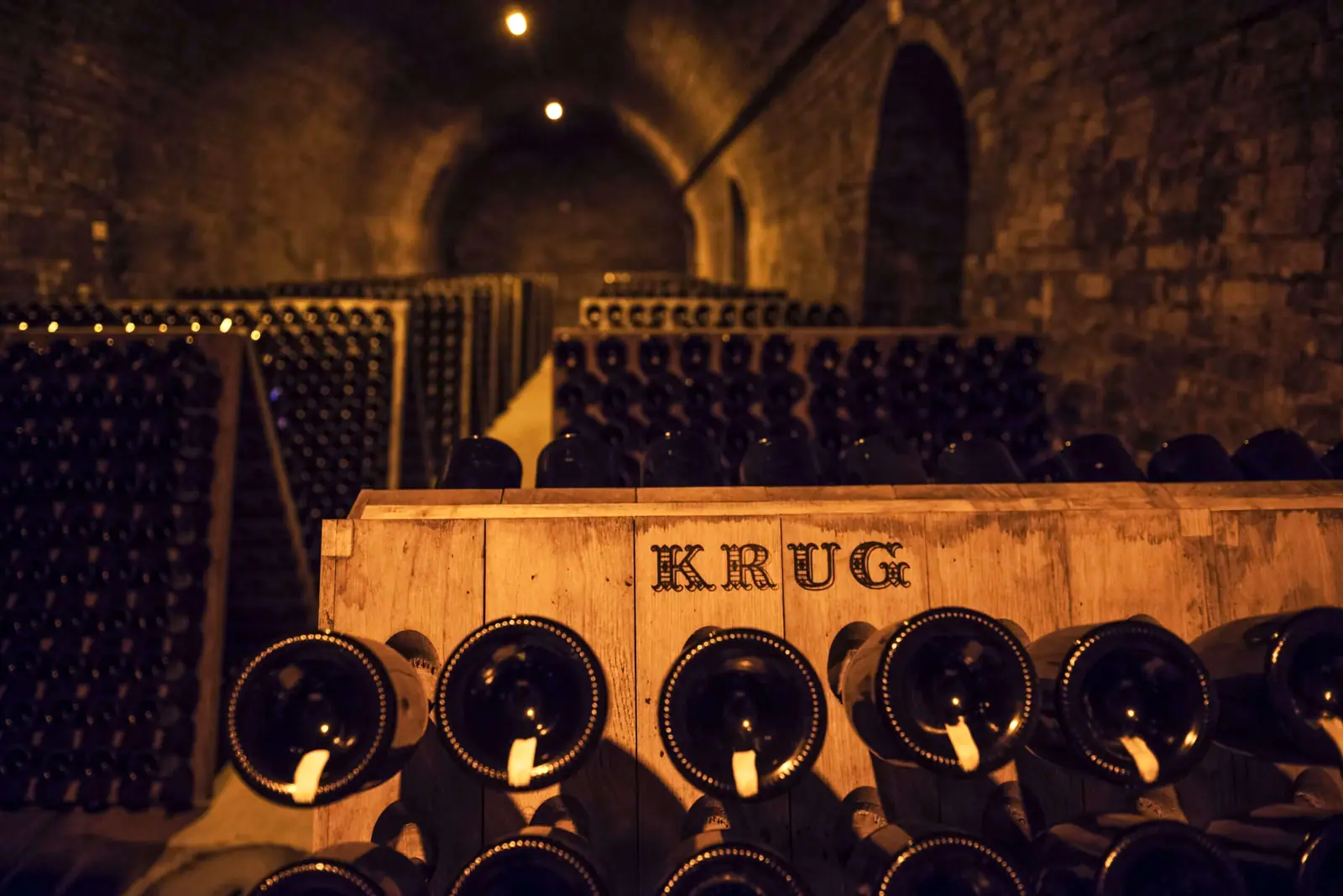
The riddling rack, or pupitre, is a wooden frame with holes in which bottles sit at an angle, neck down, and are turned and tilted a little each day. This gathers the yeast sediment against the cork.
01Riddling rack (pupitre)
The legendary riddling rack is a frame from Champagne whose main job, after the second fermentation, is to clear the wine of its yeast. Before the ageing period ends, the bottles are moved into these racks. They are slid neck first, at an angle, into the holes of large wooden boards and turned and tilted slightly every day, until at the end of the riddling period they stand almost vertically on their heads. In this way all the deposit collects right against the cork.
Done by hand, riddling takes two to three months. With a machine (a so-called gyropalette is a rack driven by electric motors) it takes about a week. Handwork is said to give the better product. An experienced remueur can properly riddle as many as 40,000 to 50,000 bottles a day. Proper riddling involves three steps:
- A slight turn of the bottle (often only a fraction of a centimetre)
- A gentle jolt, to shift the yeast sediment along the wall of the bottle
- A slight increase in the angle of the bottle in its hole in the rack
Monsieur DeSousa of the champagne house DeSousa & Fils demonstrates how his excellent champagnes are riddled.
Riddling of this kind in the rack exposes the wine in the bottle evenly to the yeast sediment. The precious aromas of the yeast can then permeate the wine better. Although many houses now use mechanical gyropalettes, they often still keep riddling by hand for their top champagnes.
In the museum of the renowned champagne house Castellane, you can see impressively how the sediment was shifted step by step in sand before the riddling rack was invented.
The invention of the riddling rack is credited to a clever Bavarian émigré named Antoine Müller and the famous Widow Clicquot. Legend has it that Madame Clicquot and her extremely gifted cellar master Müller began their experiments at the kitchen table, which they perforated accordingly as a kind of prototype.
Pictures




 0 %
