
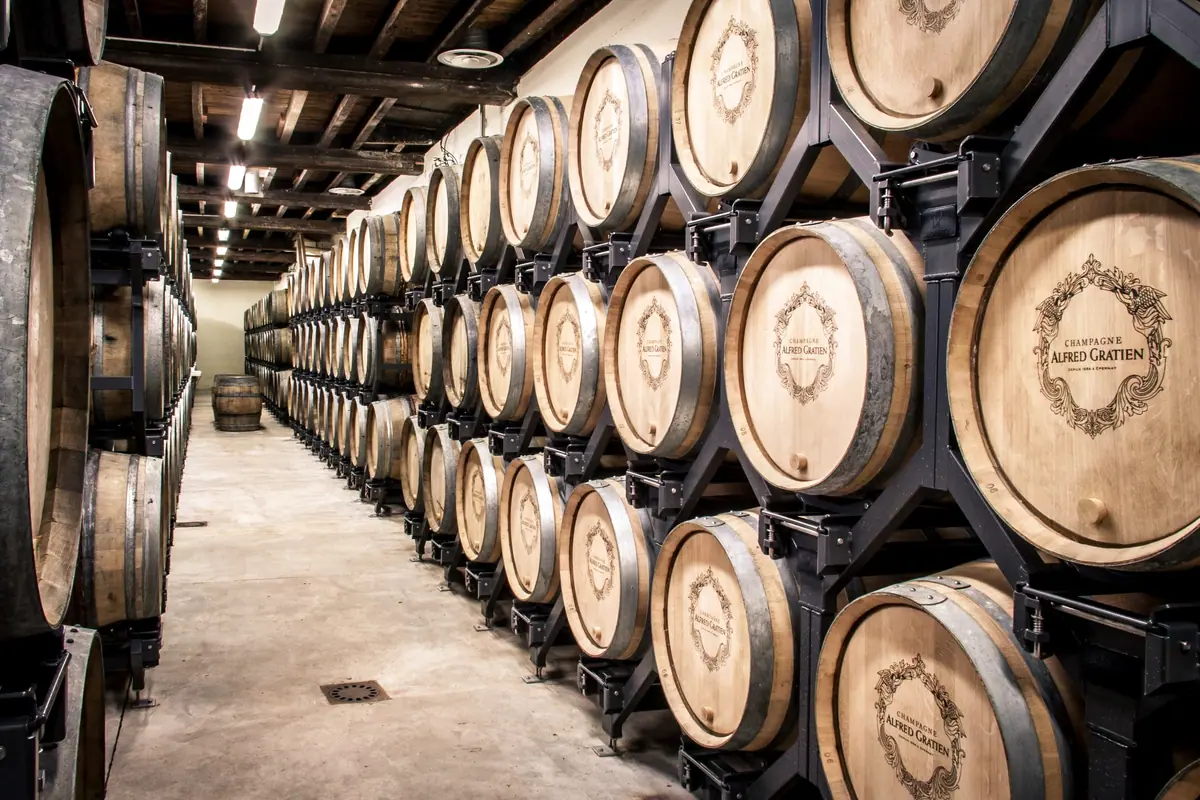
Tertiary aromas are the scents and flavours that only develop with long ageing, such as nuts, honey, toasty notes or forest floor. In champagne they define mature cuvées and vintages.
Tertiary aromas are the notes that do not come from the grape or from fermentation, but from the finished wine developing over years. In champagne they show particularly clearly, because ageing is a fixed part of how the wine is made.
How they differ from primary and secondary aromas
Primary aromas come from grape variety, site and vintage: citrus, apple, red berries, chalk. Secondary aromas arise during fermentation and through the work of the yeast. Tertiary aromas come afterwards, through slow chemical changes in acids, esters, amino acids and sugars. The boundary is fluid. The brioche and toast notes from yeast autolysis in particular are classed as secondary by some writers and as tertiary by others. What matters in the end is the overall picture: the more the fruit recedes and nuts, honey or pastry take over, the more mature the wine seems.
Typical notes in champagne
Commonly described are hazelnut, almond, walnut, honey, caramel, dried apricot, baked apple, coffee, smoke and tobacco. In very old bottles, mushroom, truffle, leather and damp forest floor join in. Chardonnay-led wines tend towards nuts and honey with the years, Pinot Noir cuvées more towards spicy, earthy tones. The mousse usually becomes finer and creamier over time, and the acidity feels rounder.
How they develop in Champagne
After the second fermentation, the wine ages on its yeast in the bottle. For non-vintage champagne the minimum is 15 months of ageing, of which at least 12 on the lees, and for vintage champagne at least 36 months. Many houses leave their wines considerably longer, especially for prestige cuvées. In addition, vins de réserve, older base wines, often contribute oxidative nuances. After dégorgement the wine goes on developing in the cellar, depending on the dosage, the closure and the storage conditions. With late-disgorged champagnes the yeast stays in contact for longer, which further supports the mature notes.
Maturity or fault?
Tertiary aromas are not a flaw, as long as they are carried by lively acidity and freshness. If the impression tips into flat, sherry-like or musty tones while the bubbles fade, the wine is past its peak. Whether you enjoy mature notes is a matter of taste. For aged bottles, a slightly higher serving temperature and a larger glass are worth trying, so the aromas can open up.
Pictures

 0 %
